Don't Let Them Mint the Medallions
Regulatory Capture and the Real Threat to the AI Revolution | Part 3 of 4

In Parts 1 and 2 of this series, I argued that the 80% job elimination narrative is economically impossible, and that what AI actually does is lower barriers to entry—producing more competition, more businesses, and a larger economic pie. But all of that depends on one condition: that the barriers stay low.
The Medallion Story
In 1937, New York City created the taxi medallion system. The intent was genuinely protective: stabilize a chaotic industry, ensure working drivers could earn a dependable living. A medallion cost ten dollars and meant you could legally operate a cab. For immigrants and young men with no family money and no connections, it was a real path into the middle class—you needed a driver’s license, a car, and a willingness to work.
Then the city stopped minting medallions. From 1937 to 1996, not a single new one was issued. Population grew. Tourism exploded. Demand surged. Supply stayed frozen. A ten-dollar medallion was worth $28,000 by 1970, $139,000 by 1989, and over one million dollars by 2013. The ladder that had lifted people into the middle class had become a wall that kept them out.
And the taxi industry’s response to ride-sharing competitors like Uber and Lyft was not innovation or better service. It was lobbying—to force ride-sharing platforms into the same medallion system or ban them outright. The incumbents did not try to compete. They tried to use government to eliminate the competition. That is regulatory capture.
The Medallions Are Being Minted Right Now
When Sam Altman sits before a Senate committee and speaks gravely about the dangers of artificial intelligence, when Elon Musk warns that AI poses existential risks, when the largest technology companies in the world call for regulation of themselves—you are watching the medallion system being built in real time.
Every regulatory framework that requires hundreds of millions of dollars in compliance infrastructure is a medallion. Every licensing regime that demands years of safety testing before a model can be deployed is a medallion. Every rule that mandates the kind of legal, technical, and bureaucratic overhead that only a billion-dollar company can absorb is a medallion. And just like the originals, these will be presented as protections—wrapped in the language of safety, responsibility, and public welfare. They will sound reasonable. They will be very difficult to argue against without appearing reckless.
But the effect will be identical. The barrier to entry will rise. The number of companies that can afford to participate will shrink. The market will consolidate around four or five firms that helped write the rules. And the thousands of small companies, independent developers, and entrepreneurial teams that would have driven the real AI revolution will never come into existence.
The real damage of regulatory capture never shows up in bankruptcy filings or market reports. It lives in absence—the companies that were never founded, the products never built, the competitors who never got the chance to drive prices down. You cannot count what was never born, and that is precisely what makes regulatory capture so effective: its greatest costs are invisible.
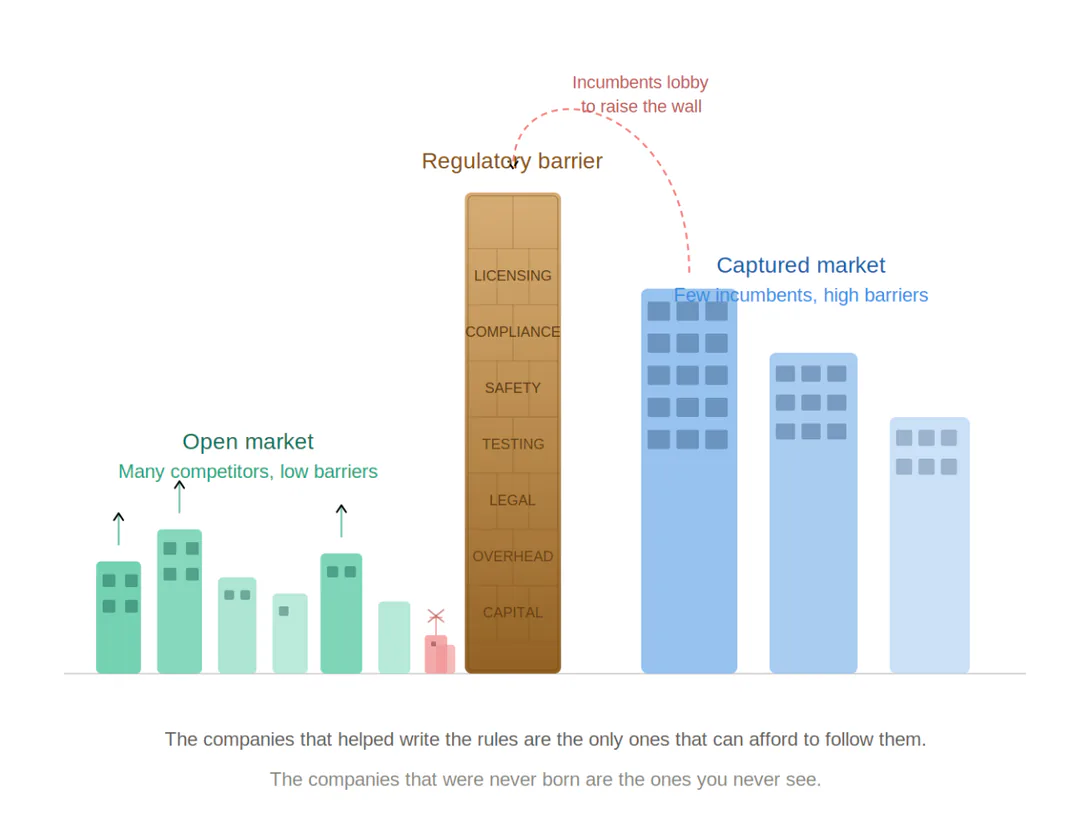
This is not a hypothetical concern. It is the explicit strategy. When an incumbent calls for regulation of its own industry, it is not being responsible. It is playing defense. These executives understand the democratization thesis better than anyone. They know that AI, left accessible, will allow small teams to compete with them directly. They know their competitive moat is about to drain. Regulation is the only way to rebuild it. Fear is the tool they use to get the public and the government to help them do it.
The Self-Driving Sequel
The medallion story has a direct sequel waiting to be written, and the irony is almost perfect: it involves the cars themselves.
Self-driving vehicles will reduce the need for human drivers. The question—the only question that matters—is who owns the cars. If regulation permits only Waymo, Tesla, and a handful of corporations to operate autonomous fleets, we have built a new medallion system. A small number of companies will own all the vehicles, extract all the revenue, and the people who currently drive for a living will have nothing.
But if regulation allows a small business owner to purchase two or three autonomous vehicles and operate a local fleet, the calculus changes entirely. The driver becomes an operator. The job changes form but does not disappear. A family that currently drives for a rideshare company can instead own a small fleet that generates revenue around the clock. The barrier to entry stays low. The value stays distributed.
The difference between these outcomes is not technological. The cars are the same. The AI is the same. The difference is entirely regulatory—a policy choice. And the incumbents are already lobbying for the version that concentrates ownership.
AI is the most powerful barrier-lowering technology in human history. Its promise is extraordinary—if we let it work. But that promise dies the moment the barriers go up. The moment the compliance costs become prohibitive. The moment the licensing regimes favor the companies that wrote them. The moment the vocabulary of safety becomes the vocabulary of capture.
Do not let them mint the medallions.
George Estrada, Chief Technology & Innovation Officer, Rize Credit Union | Founder, Orion Digital Services
Originally published on LinkedIn, 18 March 2026