Raise the Floor
Healthcare, Education, Smart Regulation, and What Getting It Right Looks Like | Part 4 of 4

In Parts 1 through 3 of this series, I argued that the 80% job elimination narrative is economically impossible, that AI’s real effect is to democratize the ability to compete, and that the greatest threat to that democratization is regulatory capture—incumbents using the language of safety to raise barriers that protect their market position. This final piece asks the practical question: what does it look like when we get it right?
The answer is not no regulation. It is regulation that lowers barriers instead of raising them, expands access instead of restricting it, and creates competition instead of eliminating it. Healthcare and education are the clearest case studies—and the stakes could not be higher.
Healthcare: More Money, Worse Outcomes
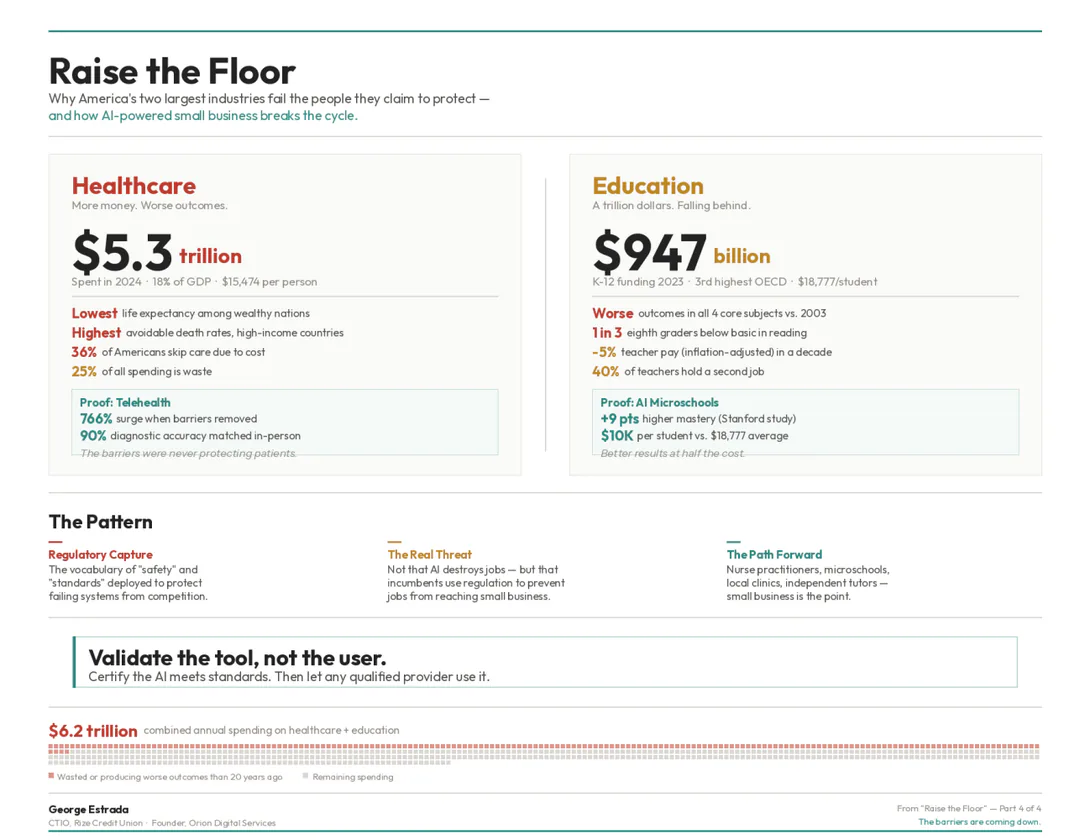
The United States spent $5.3 trillion on healthcare in 2024—$15,474 per person—consuming 18% of the entire GDP. That is roughly twice what comparable wealthy nations spend per capita. And what do we get for it? The U.S. has the lowest life expectancy and highest avoidable death rates among high-income countries. Thirty-six percent of Americans skip or delay needed care because of cost, compared to 3.6% in the European Union. Health policy researchers estimate that roughly one-quarter of all U.S. healthcare spending goes to waste. The system is not underfunded. It is failing. The people invoking “safety” to prevent AI diagnostic tools from reaching nurse practitioners in rural clinics are defending a system that is already failing the patients it claims to protect.
We have proof that tearing down regulatory barriers works. Before COVID-19, only 14% of physicians used telehealth. The AMA and state medical boards had spent years maintaining restrictions that kept virtual care marginal. Then the pandemic forced CMS to waive those restrictions, and telemedicine encounters surged 766% in three months. By 2022, 80% of physicians were using telehealth, with diagnostic accuracy matching in-person care nearly 90% of the time. When the government briefly pulled those flexibilities during a 2025 shutdown, telemedicine visits dropped 24% nationally in seventeen days. The barriers were never protecting patients. They were preventing access. The question is whether we wait for another crisis before allowing AI to do for diagnostic capability what telehealth did for geographic reach.
Education: A Trillion Dollars and Falling Behind
K-12 public schools received nearly $947 billion in funding in 2023. New York spends $32,284 per student. Nationally, inflation-adjusted spending per child has risen from $3,801 in 1960 to over $18,777—the third-highest per-pupil spending among OECD nations. The 2024 Nation’s Report Card showed that student outcomes in all four core subjects were worse than in 2003. One in three eighth graders performs below basic in reading. For low-income students, performance was worse than two decades ago. Meanwhile, the average teacher earns $74,200—which is 5% less than a decade ago adjusted for inflation. Forty percent hold a second job. The system simultaneously overspends on bureaucracy and underpays the people who actually teach. The education establishment will tell you the answer is more funding. We have been testing that hypothesis for sixty years. It is not working.
Now consider an alternative. A microschool—one teacher, twenty students, augmented by AI tutoring tools—can deliver dramatically better outcomes at a fraction of the cost. Microschool tuition typically ranges from $8,000 to $15,000 per year. At $10,000 per student with a class of twenty, that is $200,000 in annual revenue—enough to pay a lead teacher well above the national average while covering technology, materials, and facility costs. A 2025 randomized controlled trial published in Scientific Reports found that students using AI-powered tutoring learned significantly more in less time than those in traditional classrooms—and reported higher engagement and motivation. A Stanford study found AI-assisted tutors achieved up to nine percentage points higher mastery rates. A systematic review of nearly 4,600 students across 28 studies confirmed broadly positive effects of AI-driven tutoring in K-12. The evidence is not ambiguous. Yet the education establishment will respond with the same reflexive objections the medical establishment deploys: safety, standards, accreditation, oversight—the vocabulary of capture, deployed to protect a system that spends a trillion dollars a year to produce results worse than a generation ago.
Raising the Floor
Small Business Is the Point
Here is what both of these examples share: the path forward runs through small business. A nurse practitioner opening an AI-augmented primary care clinic in a rural community. A teacher launching a microschool in a neighborhood the district has written off. A diagnostic imaging startup serving the underserved county hospital. An independent tutoring practice reaching the kids who fell through the cracks. These are not billion-dollar enterprises. They are small businesses—the kind that have always been the backbone of American communities. They are run by people who live where they work, whose kids attend the same schools, who show up at the same town council meetings. The value they create stays in the community because they stay in the community.
Will AI eliminate 80% of the jobs inside large conglomerates? Maybe. I hope so. But that is not a crisis—it is a redistribution. Those roles do not vanish. They scatter outward into the communities where they belong, carried by people empowered with tools that let a five-person firm deliver what previously required a five-hundred-person bureaucracy. The real threat is not that AI destroys jobs. It is that incumbents use regulation to prevent those jobs from migrating to the small businesses and local practitioners who would create more value, in more places, for more people. Every licensing requirement designed for a company with a billion-dollar legal department, every approval process that only the largest health systems can navigate, every accreditation framework that assumes education must look like a factory—these are medallions by another name. And they are the only thing standing between AI’s democratizing potential and the communities that need it most.
What Smart Regulation Looks Like
The principle is straightforward: validate the tool, not the user. Certify that an AI diagnostic system meets defined accuracy and safety standards—rigorously, transparently, with real clinical evidence. Then allow any qualified provider to use it. Certify that an AI tutoring platform meets defined learning outcome standards. Then let any qualified educator deploy it. Federal policy should incentivize small businesses to adopt AI tools—through tax credits, grants, and simplified frameworks—not penalize them with compliance regimes designed for Fortune 500 companies.
None of this means no regulation. The original taxi medallion system was a genuine attempt to solve a real problem, and for decades it worked. Regulation becomes capture when it stops serving the people it was designed to protect and starts serving the incumbents who figured out how to exploit it. We can tell the difference. We just have to be honest about which one we are looking at.
The Vision
Ten years from now, if we execute properly, we do not have fewer doctors or fewer teachers. We have nurse practitioners running AI-augmented clinics in communities that have not had a primary care provider in decades. We have teachers earning six figures leading microschools where twenty students get the personalized instruction that a class of thirty-five never allowed. We have more healthcare encounters, better outcomes, higher graduation rates, and stronger local economies—not because we spent more money, but because we let the right people use the right tools in the right places.
The 80% narrative—the idea that AI will eliminate most jobs and leave the economy in ruins—is not a prediction. It is a strategy. It is the opening argument in a campaign to scare the public into accepting a regulatory framework that protects monopolists from the very democratization AI makes possible. We spend $5.3 trillion a year on healthcare and rank last among wealthy nations in outcomes. We spend nearly a trillion dollars a year on K-12 education and our students perform worse than they did in 2003. The institutions demanding we trust them with the future of AI regulation are the same institutions that presided over these failures. The people telling you to be afraid are not warning you about the economy. They are warning you about what is coming for THEIR business model.
The barriers are coming down. The only question is whether we let them stay down.
George Estrada, Chief Technology & Innovation Officer, Rize Credit Union | Founder, Orion Digital Services
Originally published on LinkedIn, 19 March 2026