The 80% Fallacy
Why the AI Doomsayers Are Wrong - Part 1 of 4

Vinod Khosla, one of Silicon Valley’s most influential venture capitalists and one of the earliest institutional investors in OpenAI, recently declared: “Starting in about 2030—four years away—80% of all jobs will be capable of being done by an AI. Whether you’re a physician, whether you’re a radiologist, whether you are an accountant, whether you are a chip designer, whether you are a salesperson, AI will do your job better.” Bill Gates, speaking on The Tonight Show earlier this year, was asked whether humans would still be needed. His answer: “Not for most things.”
These are not fringe commentators. Khosla helped build Sun Microsystems and has shaped the trajectory of companies from Square to Instacart. Gates co-founded Microsoft and has spent two decades as one of the most influential voices in global technology and philanthropy. When people of this stature tell you, with straight faces, that 80% of the labor force is about to disappear, the prediction itself becomes an economic event—it shakes consumer confidence, chills hiring decisions, and sends policymakers scrambling toward bad solutions for a problem that does not exist as described. These men are either too careless to understand the damage their words inflict on the very economy they claim to be revolutionizing, or they understand it perfectly well and are saying it anyway. Either way, you should pay very close attention to what they are not saying.
I am deeply skeptical. Not because I doubt the power of AI—I work with it every day, and I understand what it can do. I’m skeptical because these predictions collapse the moment you follow the money through a single complete cycle. And once you see the failure, you start to see something far more interesting: what AI will actually do to the economy, which is not destroy it but restructure it in ways that are profoundly positive—and profoundly threatening to the people making the doom predictions.
The Demand-Side Collapse Nobody Mentions
The 80% prediction sounds dramatic and futuristic, but it contains a fatal assumption: that companies can eliminate the vast majority of their workforce and continue generating the same revenue. This is not how economies work. Revenue is what happens when people who have jobs spend the money they earn. Cut the jobs, and you cut the spending. Cut the spending, and you cut the revenue. There is no version of this where the math works.
Consider a simple illustration. A town has ten businesses that collectively employ 1,000 people and pay $10 million in total wages. Those workers spend their wages at those same ten businesses, generating $10 million in revenue. Now suppose every business automates 80% of its workforce. Labor costs drop from $10 million to $2 million—“$8 million in savings.” But 800 people just lost their income, and those 800 people were the customers. Revenue doesn’t hold at $10 million. It crashes to roughly $2 million—the amount the remaining 200 workers still earn and spend. The “savings” and the “revenue loss” are the same money, viewed from opposite sides of the ledger. The companies did not become more profitable. They became insolvent.
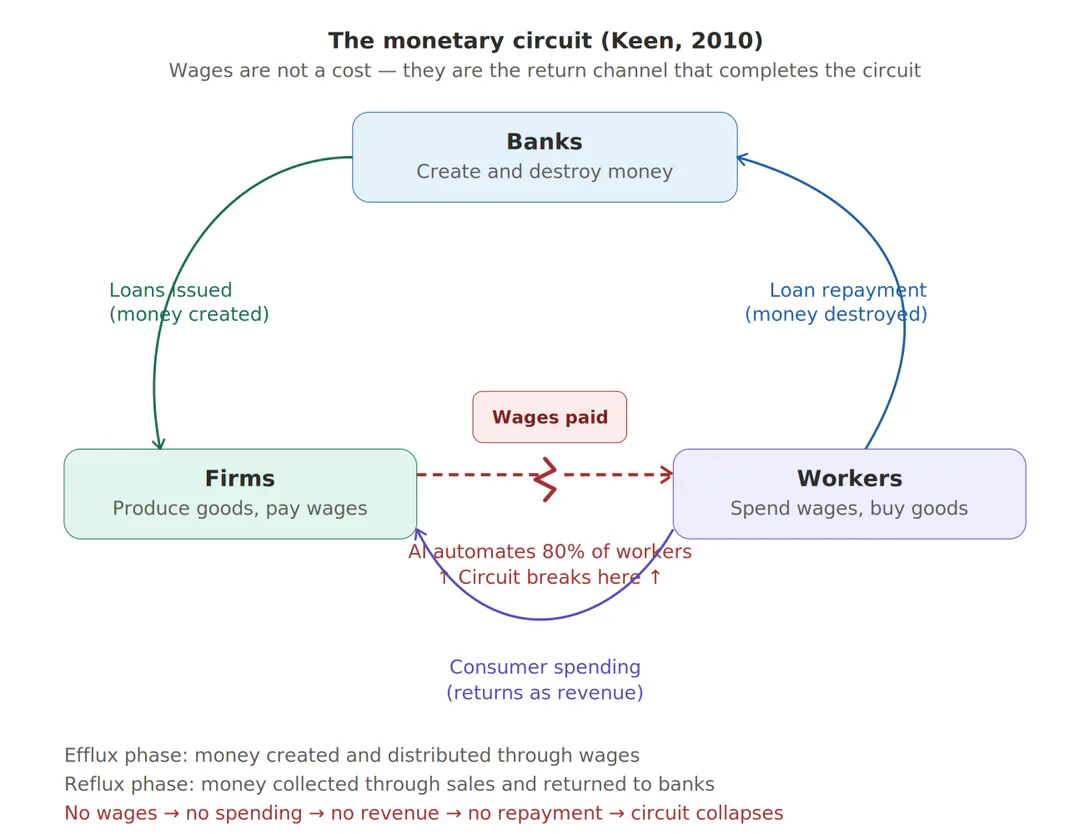
This is not just intuition—it is what monetary circuit theory predicts. Steve Keen’s formal model of the monetary circuit shows that in a credit economy, wages are not a cost that firms pay out of existing wealth. They are the mechanism by which money flows through the system and returns as revenue (Keen, 2010). Banks create money when they issue loans to firms; firms pay workers; workers spend; firms collect revenue and repay the bank. Eliminate the wage channel, and you do not save money—you break the circuit that generates it. The loan still exists. The revenue does not.
The UBI Fantasy
When confronted with the demand problem, Silicon Valley’s standard response is Universal Basic Income. The government will tax the corporations that replaced their workers and redistribute that money to the displaced population. It sounds elegant. It is not.
Trace the money. Companies automate 80% of their workforce. Revenue collapses because customers have no income. There are no massive profits to tax because there are no massive revenues. UBI funded by corporate taxes assumes the tax base is independent of employment—that companies keep making money regardless of whether people have jobs. But revenue comes from customers, and customers get their money from employment or from government transfers funded by that same revenue. It is circular. Every pass through the loop loses value to friction: administrative costs, savings rates, debt repayment, imports. Within a few cycles, the pool drains to nearly nothing.
The deeper problem is what Keen calls the stock-flow confusion—what Michael Kalecki once called “the science of confusing stocks with flows.” Silicon Valley sees $8 million in wages as a stock—a pile of money that could be replaced by a government check of equal size. But wages are a flow. That $10 million cycles through the economy dozens of times per year at specific speeds: paychecks every two weeks, consumption spending within days, production cycles every couple of months. In Keen’s model, the velocity of that circulation is what generates an economy many times larger than the money supply itself (Keen, 2010). UBI might match the stock. It cannot replicate the flow. And without the flow, the economy that Silicon Valley wants to tax simply ceases to exist.
Imagine you tax surviving revenue at 80%. The government collects it and distributes it as UBI. People spend it. The businesses receive it as revenue, and 80% gets taxed again. Each lap around the track, the money shrinks. You are not sustaining an economy. You are watching one slowly bleed out.
UBI is not a solution to mass unemployment. It is a narrative device—a line these executives use to keep the conversation polite while describing an economic apocalypse they have no actual plan for…or do they?
If the 80% prediction is economically incoherent, then the real question is not whether AI will destroy jobs. The real question is what AI will actually do. The answer, as every previous wave of enabling technology has shown, is far more interesting—and far more threatening to the people telling you to be afraid.
References
Gates, B. (2025, February 4). Interview on The Tonight Show Starring Jimmy Fallon. NBC. https://www.cnbc.com/2025/03/26/bill-gates-on-ai-humans-wont-be-needed-for-most-things.html
Keen, S. (2010). Solving the paradox of monetary profits. Economics: The Open-Access, Open-Assessment E-Journal, 4, 2010-31. http://dx.doi.org/10.5018/economics-ejournal.ja.2010-31
Khosla, V. (2026, March 6). Interview on Fortune 500: Titans & Disruptors of Industry podcast. Fortune. https://fortune.com/2026/03/06/vinod-khosla-predicts-80-percent-of-jobs-done-by-ai-15-trillion-of-gdp-going-away/
George Estrada | Chief Technology & Innovation Officer, Rize Credit Union | Founder, Orion Digital Services
Originally published on LinkedIn, 16 March 2026