Seize the Means of Computation: Part One
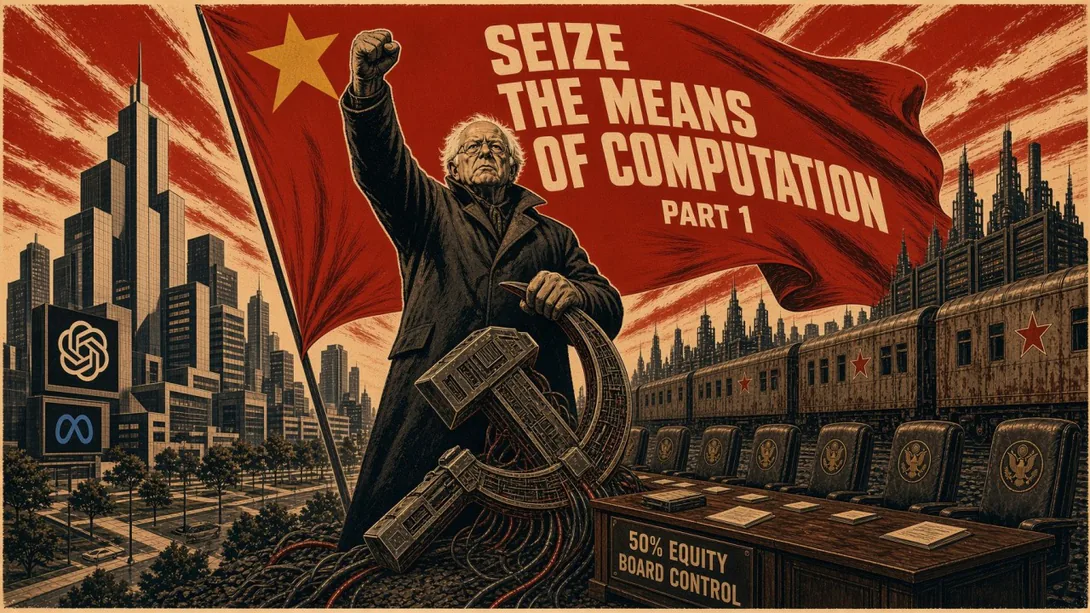
I've been critical of Mr. Sanders for a while. In April, I wrote a piece called "Sanders is Wrong about AI," walking step by step through his Wall Street Journal op-ed calling for a moratorium on building data centers. Then, on June 1, he published a follow-up in The New York Times proposing the American AI Sovereign Wealth Fund Act, which would give the public a 50% ownership stake in America's AI companies. Unfortunately, I'm going to have to keep being very critical. This isn't a personal thing. It's an obligation, as a technologist and a leader, to call out bad ideas when they're bad. And Mr. Sanders is just full of bad ideas.
In that op-ed, titled "The Public Should Own Half of the Big A.I. Companies," Sanders calls for what he labels a tax but is really a takeover. The word tax is doing an enormous amount of hiding here. Today, the federal government's stake in these companies is zero. Under the Sanders plan, it would be 50%.
A tax is a slice of money. This is a company takeover: half the equity, paid in stock, with board seats and voting control. The federal government is installed as co-owner of the very firms it also regulates. Now, call me a fool, but that's what is known as communism by another name.
The foundation of his piece is that AI is built on the collective knowledge of humanity. Fair enough, and I'll grant there are real grievances buried inside that claim. The overwhelming majority of these models were trained on copyrighted work without paying for it. To put that in context: if I built a product on Star Wars the way they built their models on protected works, I'd be sued into the ground and quite possibly jailed. That grievance is real, and I have no problem arguing it for the many artists who may have been wronged in these build-outs. What I do have a problem with is the collective knowledge of humanity used as a deed of ownership.
Follow it to its logical conclusion and you see the lunacy behind that logic. Walt Disney built an empire walking on the public domain. Snow White, Cinderella, Pinocchio, Hercules: fairy tales, folktales, and myths taken for free from the collective creative work of mankind. By Sanders' reasoning, that extraction from the commons, the very thing he accuses the AI labs of, demands a 50% stake from Disney, Warner, Universal, Netflix, and it goes on and on and on.
The irony writes itself. Disney took from the commons for free, then lobbied for decades to keep its own work out of it, so effectively that the 1998 copyright extension got nicknamed the Mickey Mouse Protection Act. In essence, Disney took the inheritance and padlocked the gate behind it.
And Sanders' principle, the collective knowledge of humanity, doesn't stop at the studio gates. Every song is built on the twelve-tone scale, every novel on 3,000 years of form, every newspaper on public events. Big Pharma's blockbusters ride on taxpayer-funded NIH research. Once "built on the commons" means "owned by the state," nothing anyone built survives, because everything humans make recombines what came before. That isn't a tax policy. It's the abolition of making something.
Sanders justifies the seizure (and it is a seizure) by saying AI stole from writers, artists, and musicians, posing as their defender. But the principle he reaches for, it's built on the collective, therefore the public owns it, is the exact principle that dispossesses those same artists, because they too built on everything before them. You can defend artists' ownership, or you can argue the collective owns whatever is built on the collective. You cannot do both in one op-ed. Mr. Sanders does anyway, and the dissonance cuts toward his own side.
Hollywood, the music industry, publishing, and newsrooms are among the most reliably progressive sectors in the country, and they would be the first to fall under his premise. The only thing standing between his principle and the nationalization of Disney is that he picked AI founders as more convenient villains for this season.
What Sanders proposes is what the mobster does. The mobster walks into the business you built and says, "Beautiful bakery. Nice neighborhood. Safe here. It's safe here because we keep it safe. We all look out for one another. So here's my proposal. You've got such a fruitful operation, I'll take half, and we'll be partners going forward. I have a seat at the table. Anyone gives you trouble, don't worry, I'm here. But remember, you didn't build this on your own. You built it in a safe neighborhood, and we're the ones who keep it safe." That, in essence, is the offer Sanders wants to make.
He also smuggles two different claims in as one: that the companies scraped data without compensation, a copyright question I'd happily see addressed in the courts, and that the companies therefore belong to the public, a nationalization claim. Then, while attacking the companies, he tries to enlist them. He cites OpenAI's proposed public wealth fund, Anthropic's mention of sovereign wealth funds holding AI stakes, and Musk's call for universal high income.
That's dishonest twice over. First, not one of them proposed handing over a 50% stake. Second, those were defensive gestures floated against the specter of mass unemployment, a separate argument. Citing them as endorsements doesn't hold.
Sanders is suggesting that the most representative, most responsible steward here is a government with a poor record of managing money. He's asking us to trust that government with the one technology likely to reset the course of civilization.
To be fair, Sanders is not alone. The appetite for a federal stake in AI runs across the aisle. Even President Trump has said a government ownership stake in the AI giants would be "a beautiful thing" that makes the American public "partners in this revolution," and his administration has held talks with OpenAI about one. When Washington took its stake in Intel, he told the company's CEO, "I think it would be good having the United States as your partner." The scale is different; the figure OpenAI itself floated was 5%, not half the company plus board seats. But listen to the pitch. Partners. Where have we heard that before? The ownership model doesn't care which party holds the shares.
Before I close, one example: the American rail system. It's a clean A/B test, and it runs exactly where this logic goes. The railroads were regulated into the ground by the ICC. Rates fixed since the turn of the century. Carriers forced to keep money-losing lines, even ordered to absorb a bankrupt railroad right before the end. The result was Penn Central, the largest corporate bankruptcy in U.S. history when it failed in 1970. No regulator wanted to kill the railroads. It happened anyway.
Then came Amtrak. Fifty years of proof. Created in 1971, never once profitable, it lost $1.8 billion in fiscal 2024, including $635 million on long-distance routes whose maps are drawn for political gain rather than ridership, because Congress orders it by law to keep running them and blocks it from making rational decisions.
Nobody set out to wreck it. The ownership model does the bleeding itself.
Same industry, two roads. Freight rail, deregulated and private: $0 in federal operating support, self-funding and profitable. Amtrak, government-owned: roughly $705 million in federal operating support in fiscal 2024, by Amtrak's own accounting. Freight was returned to private hands and thrives. Passenger rail stayed with the government and has lost money every single year for half a century. The government took the railroads over to rescue a dying industry and still couldn't run it. And now Sanders wants to seize the fastest-growing, most valuable industry of the century at its peak.
He wouldn't be burning the AI labs down. He'd be turning them into the Amtrak of intelligence and calling it a gift to the people. Malice you can vote out. Structural incompetence is baked into the ownership model. Sanders wants us to believe you can hand the state half of the most consequential technology in history and trust it to be the gentle owner.
So are there dangers in the concentration of wealth and power in so few hands? Absolutely. But you don't fight that by seating the government at the same table as those few. You fight it by keeping competition alive. The work in front of us is to outbuild the problem, not to hand it to the one partner we can never vote out, never walk away from, and never refuse.
This is the first of a two-parter. When I read that op-ed back in June, I thought, "Man, Sanders is full of bad ideas." And lo and behold, on September 3, 2026, Mr. Sanders introduced the Ban Artificial Superintelligence Act. That will be the subject of my next piece.
EoM
Originally published on LinkedIn, 11 September 2026