Availability Is Not Adoption

Reading The 2026 Global AI in Financial Services Report: Adoption, Impact and Risks from the University of Cambridge Judge Business School, and the study has some interesting results.
Four out of five financial firms now use AI. One in seven says it changed anything. That gap — 81% adopting, 40% at advanced maturity, 14% calling it transformational — this is a structural failure that I’ve been seeing over and over again through my own work and consultations, and it’s nuanced.
Most institutions run three AI programs and call it one. Security writes the policy. Training happens wherever there’s capacity. Adoption is nobody’s named job. All three can report green while the program accomplishes nothing, because each is reporting an input — policies written, sessions delivered, licenses provisioned — and none can report whether the right people are doing the right work.
Two sources changed how I think about this and influenced my strategy.
The first was a session Ai4 2026 by Tim Fox, Chief Data and AI Officer at Ogletree Deakins, presenting the firm’s two-year AI journey in August 2026 (Fox, 2026). Their lesson, stated plainly: the launch is the beginning of the deployment, not the finish line. They assumed people would find the tools. Roughly ten to twenty percent did — the early adopters who find anything you turn on. Everyone else needed somebody to show them. Their single most effective adoption event wasn’t a training; it was a practitioner standing up at a regional meeting explaining how he used it. And the audience they initially ignored — business professionals rather than attorneys — became the majority of their users.
The second was a randomized trial of 640 small business owners published in MIT Sloan Management Review, How AI Helps The Best And Hurts The Rest, (Otis, Clarke, Delecourt, Holtz & Koning, 2026). On average, the AI adviser did nothing. The difference between groups was statistically indistinguishable from zero. However, when they disaggregated their data, that zero contained two opposite effects. Strong performers gained roughly 15%. Weak performers lost close to 10%. Same tool, same quality of advice — the variable was the judgment to sift it. On open-ended work, AI amplifies judgment rather than supplying it.
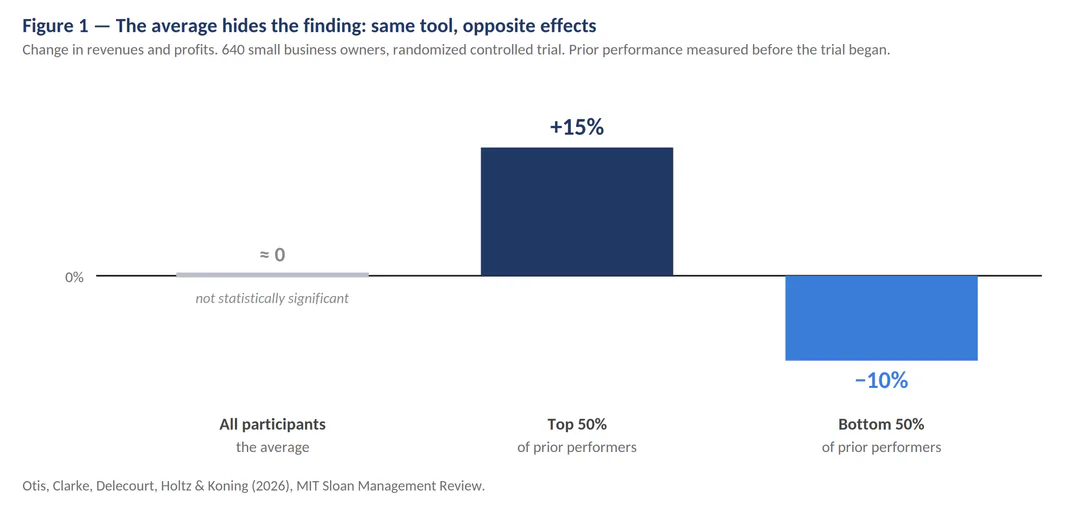
The conclusion is uncomfortable when you consider conventional wisdom: the people being harmed look identical to your best adopters on a volume report. Heavy use with weak judgment is not a mild version of good adoption; it’s the profile that lost money. They’d be first on your list of demonstrators and last on your list of concerns, and both would be exactly backwards.
The map that stops you making that mistake
Your workforce is not one population, and generic AI training fails for a structural reason rather than a content one — it assumes it is. But the populations aren’t a list, either. They’re the four cells of a two-axis map, and the second axis is the one almost nobody measures.
Engagement — how much someone uses AI — is easy to count and is what every usage report shows. Sophistication — how well they use it — is the axis the MIT trial says actually determines whether the tool helps or harms. Plot both and four groups separate that a volume report collapses into one.
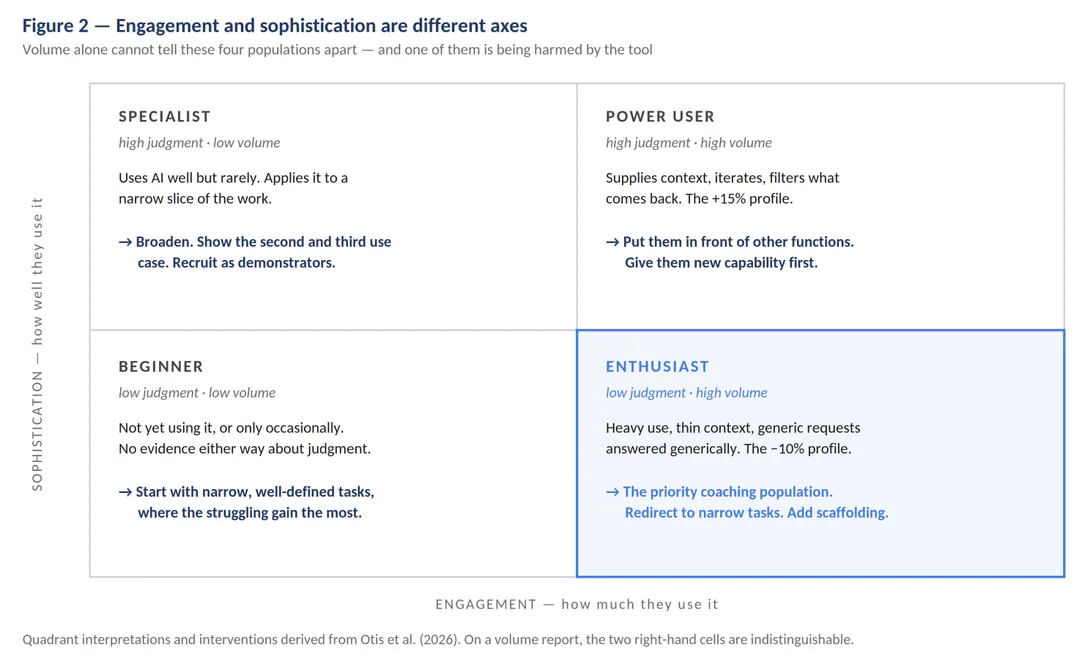
Each cell gets a different conversation. Power users supply context, iterate, and filter what comes back — the +15% profile. They get new capability first and get put in front of other functions. Specialists have the judgment and lack the reach; they’re your demonstrator bench, and they need the second and third use case. Beginners need narrow, well-defined tasks, because there the direction of the MIT finding flips: on tightly scoped work, the people struggling most benefit most, since the output needs little modification and far less judgment to apply.
And enthusiasts — heavy use, thin context, generic requests answered generically — are the priority coaching population. They are also, on every dashboard on the market, indistinguishable from your power users.
Why nobody is doing this
The report explains the gap. Fifty-five percent of institutions say they find it difficult to measure what their AI is worth, and that climbs to 76% among large institutions. Scale normally improves measurement; here it degrades it, because AI spreads across functions, vendors and cost centers and no single owner holds the full picture.
Only 10% describe their workforce as highly prepared for AI. Firms reporting profitability from AI were nearly four times likelier to say theirs was. And the barriers haven’t moved: data quality and talent were the top two constraints in Cambridge’s 2020 study and remain the top two now. Five years, a technological generation, same two answers.
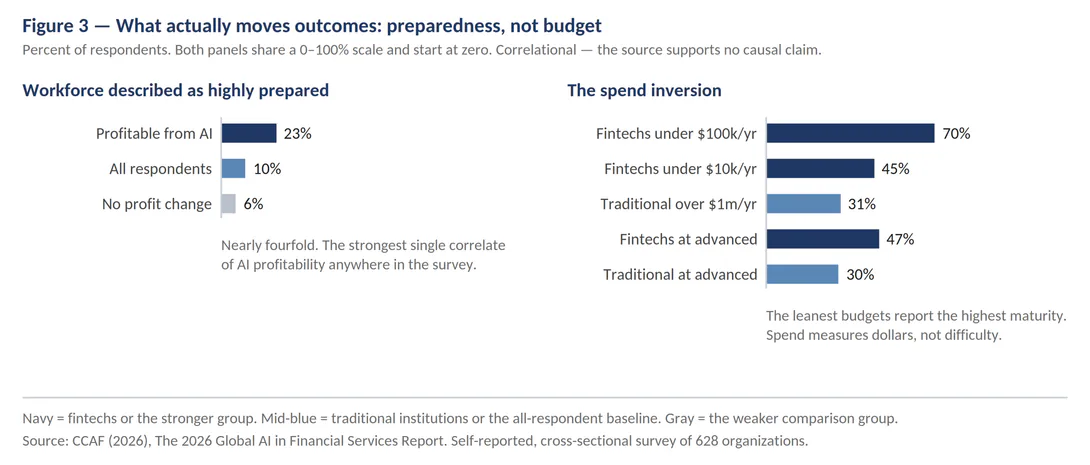
The spend data makes the point sharper. In aggregate, higher spend tracks higher maturity — 62% of organizations above $100,000 a year reach advanced adoption. But between segments it inverts. Both are true, because spend measures dollars rather than difficulty. Budget is not the lever. Preparedness is.
Where the populations actually live
Here is where the law firm session and the Cambridge data say the same thing from different directions.
Ogletree focused almost entirely on attorneys, reasoning that attorneys generate revenue and business professionals would follow. They didn’t — they wouldn’t touch a platform they perceived as an attorney tool, even when told they could use it. Eighty percent of roughly 1,100 attorneys is about 880 users, yet the firm reports over 2,000 monthly active users. More than half their AI user base turned out to be the audience they initially ignored.
The Cambridge data shows the same shape across the sector.
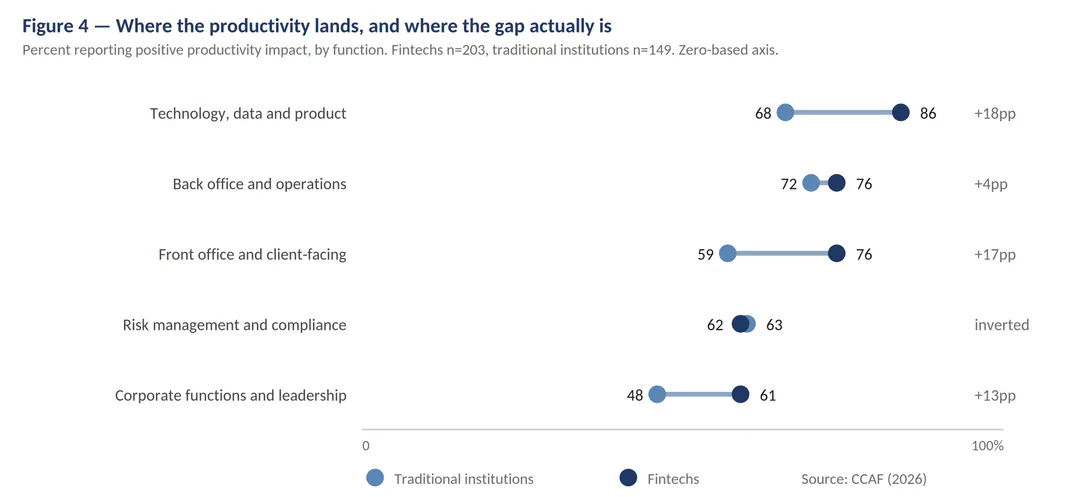
Productivity gains run highest in technology, data and product and fall away steadily toward corporate functions and leadership. The sector has instrumented the technical back office and left the operational one alone.
The firm-type splits underneath are where it gets useful. Fintechs outrun traditional institutions by 18 points in technology and product and 17 in front-office roles — but the two converge in back office, and traditional institutions are marginally ahead in risk and compliance. The gap isn’t general capability. It’s concentrated in specific functions, which means it’s addressable by targeting rather than by spending.
In a credit union the equivalent split is customer-facing staff and back-office operations, often with a third once lending or underwriting separates out. Each needs its own entry point, its own examples, its own named use cases. In most institutions the majority of staff do not hold the licensed or revenue-generating role the program was designed around — which makes that population the single largest untapped opportunity, and the one nobody instruments.
Who does the teaching
The other lesson from Ogletree is that nobody wants to hear about AI from the person whose job is AI. They want to see a colleague do it and hear how. Their most effective adoption event was a shareholder explaining his own practice to a room — standing room only, and it moved adoption for that group more than any webinar series had.
That’s why the specialists matter. Judgment without reach is a demonstrator bench waiting to be used, and the pairing that works is across functions rather than within them. Pair your heaviest lending user with operations, not with lending again. Independent research points the same way: in a Microsoft study of one AI tool’s rollout, usage among an engineer’s skip-level peers — not their immediate team — was the strongest predictor of whether they tried the tool at all.
What this changes about reporting
Once you can see four populations, the reports you were producing stop being useful. Average productivity gain across the organization is the first thing to go: Figure 1 shows an average of zero containing a 15% gain and a 10% loss simultaneously. Users with access measures procurement, not adoption. Total prompts is volume without depth or task shape, which says nothing about whether the use is the kind you want.
What replaces them: the distribution rather than the average. Depth of use — prompts per active user, month over month, by function. Exposure concentration by named user with coaching status. Spend per productive user rather than total model spend.
Cambridge draws the consequence for anyone writing an investment case in this period: with no cross-industry benchmarks for AI-specific returns, the case has to carry a share of the measurement work itself. Nobody is going to hand you the baseline.
The honest limit
Telemetry sees the interaction, not the outcome. It can tell you who used what and how well. It cannot tell you whether the work got better — that requires joining AI usage to business results, which is a data project rather than a platform feature. If you never close that loop, you'll be able to prove adoption and unable to prove value.
I believe the key to closing this loop is high-fidelity data with precision calibration, so that up and down the chain we are not only leveraging targeted training, but capitalizing on the amplification effect of the people who already know how to use these tools — who are quicker to recognize what a situation calls for and to apply judgment to it. That is fine-tuned amplification rather than broad enablement, and it is only possible when you can tell those people apart from everyone else in the first place.
Instrument first, then train, then scale. Not because measurement is virtuous, but because the population that most needs your attention looks like your best adopters on every report you currently produce.
More to come...
EoM
Sources
Cambridge Centre for Alternative Finance. (2026). The 2026 Global AI in Financial Services Report: Adoption, impact and risks. University of Cambridge Judge Business School. [link]
Otis, N., Clarke, R., Delecourt, S., Holtz, D., & Koning, R. (2026). How AI Helps the Best and Hurts the Rest. MIT Sloan Management Review, Summer 2026, 9–11.
Fox, T. (2026, August). 1,100 Attorneys, One Million Prompts: Our AI Journey. Ai4 2026 Conference session, Ogletree Deakins.
Originally published on LinkedIn, 14 September 2026