The Job That Never Makes the List: Why the AI-Doom CEO Chorus Is Not Candor
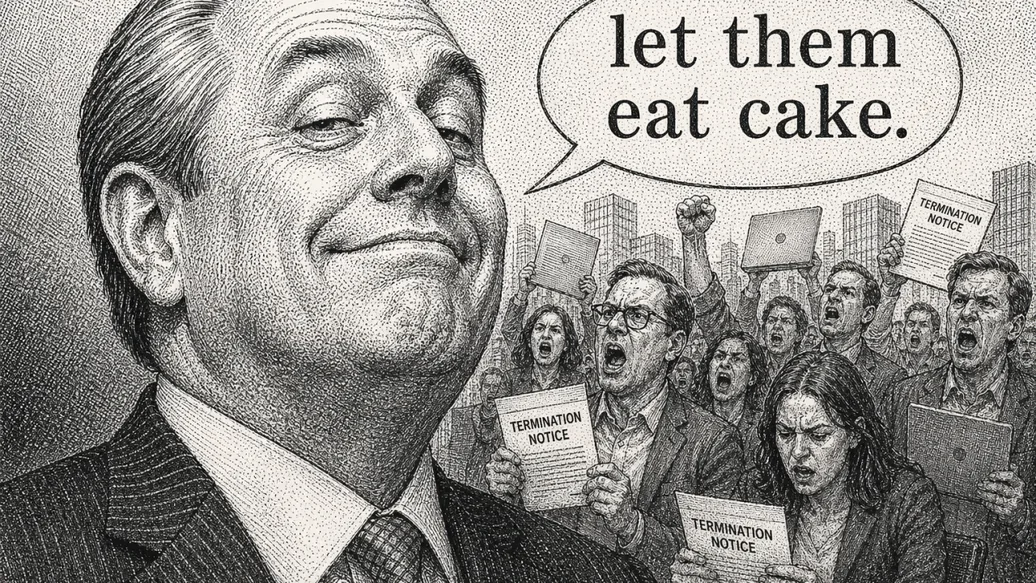
In a piece title, The CEO Preaching Straight Talk About AI and Job Losses, Verizon CEO Dan Schulman recently told the Wall Street Journal that advances in AI and robotics could push unemployment to 20 to 30 percent within two to five years. Anthropic CEO Dario Amodei has floated a similar scenario, warning that AI could wipe out roughly half of entry-level white-collar jobs and spike unemployment by up to 20 percent within five years. Sam Altman and Bill Gates have made less numerically specific but directionally similar predictions. A growing number of Fortune 100 CEOs now describe AI as a force that will eliminate substantial portions of their workforces. The Journal piece on Schulman was framed as bracing honesty — a refreshingly candid leader willing to say what others won’t. It is not. It is irresponsible forecasting — weak leadership dressed as vision.
A CEO predicting 30 percent unemployment is either making an operational forecast — in which case they owe shareholders a plan for who buys their products in that economy and why their own role survives the displacement — or performing for cameras, in which case they should stop. Instead of telling Verizon employees to use AI to write their own obituaries — an edgy gesture in place of an answer — Schulman should be walking shareholders through how Verizon generates revenue in the economy he just forecast.
Let's start with what AI is actually doing. Anthropic’s Economic Index shows Claude earning its place in coding, office work, writing, and task delegation — roughly 49 percent of jobs see at least a quarter of their tasks performed using Claude, and enterprise API usage runs 77 percent automation-oriented. Real but bounded productivity lift, not the blanket automation the doomsayers invoke. And even that narrow lift isn’t translating at the organizational level: MIT’s 2025 GenAI Divide report finds 95 percent of organizations report no measurable ROI despite tens of billions in spend, and IBM puts average enterprise AI ROI at 5.9 percent against a cost of capital near 10 percent — most programs destroy value. AI is transforming specific tasks and failing to transform organizations. The doomsayers are extrapolating from the first fact as if it proved a forecast of mass unemployment. It doesn’t.
If you predict the trigger, you must account for the avalanche. Otherwise the forecast is not boldness. It is innumeracy dressed as vision. Look closer at what these CEOs are actually predicting, whether they realize it or not.
At the peak of the Great Depression, US unemployment hit roughly 25 percent. Across the industrialized world, it ran higher. Those levels did not sit quietly in the data. The United States rewrote its social contract through the New Deal. Germany, Italy, and Japan produced authoritarian regimes that ended in world war. France cycled through six governments in as many years. Every instance of 25 to 30 percent sustained unemployment in modern history has accompanied at least one of: major war, sovereign debt crisis, banking collapse, currency crisis, or political regime change.
When Schulman, Amodei, Altman, or Gates casually forecasts 20 to 30 percent sustained unemployment from AI, they are not making a labor-market prediction. They are describing historic rupture — the kind of unemployment that rewrites the social contract, not the kind that shows up in a quarterly report.
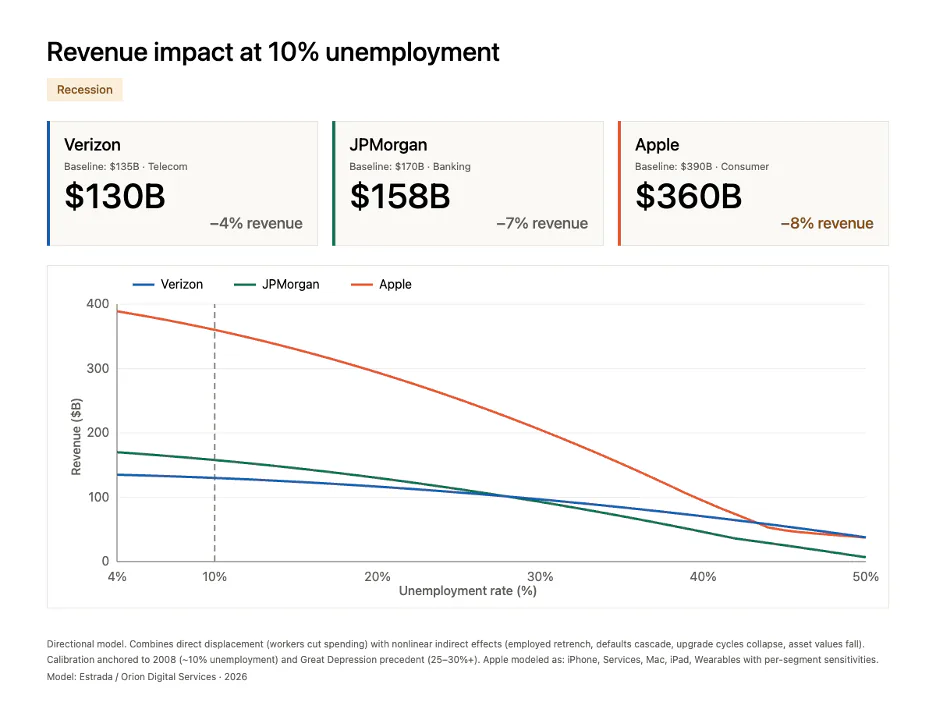
A simple revenue-impact model makes the point concrete. At 10 percent unemployment — the 2008 peak — Verizon loses about 5 percent of revenue, JPMorgan loses 22 percent, Apple loses 16 percent. Painful, but familiar.
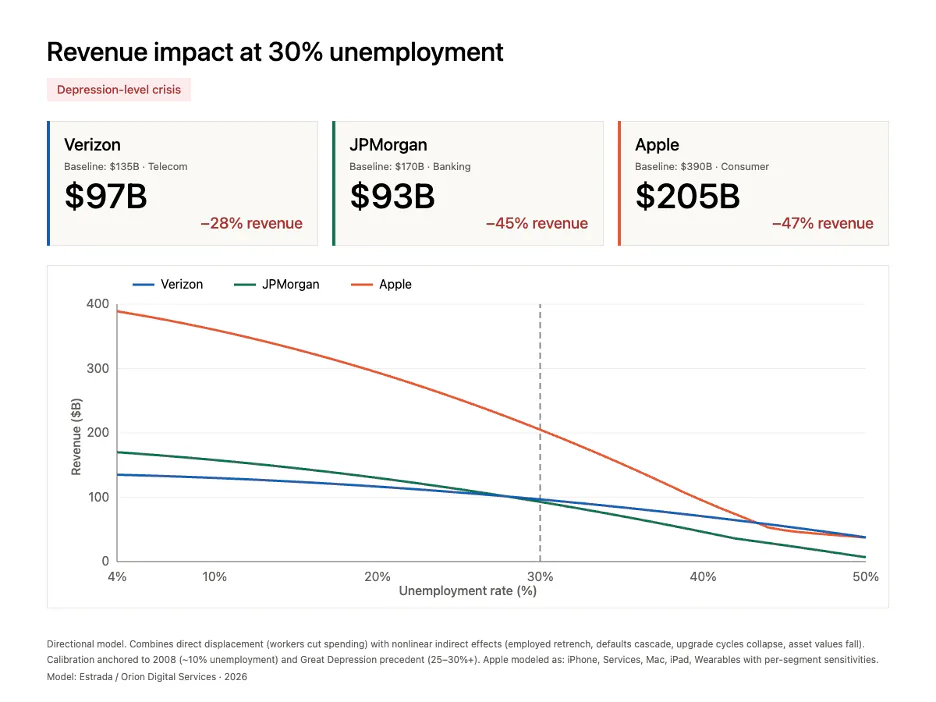
At 30 percent — the doomsayers’ range — Verizon drops 28 percent, JPMorgan 55 percent, Apple 52 percent. And those numbers assume nothing else goes wrong. Historically, nothing else going wrong at that unemployment level is probability zero. Sovereign defaults, banking failures, currency crises, and political rupture are not risks in this scenario; they are features of it.
CEOs across industries tossing off 30 percent unemployment as the new normal is the modern-day “let them eat cake.” Things did not end well for those in power at the time of that quote. Leadership — the kind the WSJ suggests is real and candid — would work at articulating how they plan to endure and manage through such a turbulent period.
If AGI is real in four years — if we really will have systems with general intelligence exceeding our own, as these CEOs insist — then the first job that goes is not the accountant, the marketer, the customer-service rep, or the developer. It is the CEO.
Think about what a CEO actually does. They synthesize information, allocate capital, set strategy, read markets, and manage stakeholder relationships. Every one of these tasks is exactly the kind of high-level knowledge work these same CEOs tell us AI will soon match or exceed. A system that can replace a division president can replace the executive it reports to.
Observe which part of the org chart is never included in the reskilling conversation.
Sam Altman predicts AI will automate 40 percent of jobs by 2030, and does not suggest OpenAI’s board should be preparing to replace him with the product he sells. Dario Amodei warns that AI could wipe out half of entry-level white-collar roles, and does not propose that Anthropic’s board should be preparing to replace him with Claude. By their own logic, AGI will make better strategic decisions than any human executive, process more information, operate without fatigue or bias, and continuously improve itself. The case for human CEOs dissolves. So does the case for human legislators, human regulators, human central bankers. Yet nobody is proposing this. Nobody is even discussing it. And what passes for journalism doesn’t bother challenging these claims.
Real candor — the kind the WSJ piece claimed to find — would be Schulman saying: “If I’m right about AGI, I should be the first to go, and the board should be planning accordingly.” No CEO has said this. And they won’t, because they don’t believe it.
If these leaders truly believe their forecast, then they must know that 30 percent sustained unemployment turns into 40 and keeps climbing — because by their own logic, AI will eventually be able to do everything. That is not an improvement. It is a civilizational crisis. One that, if real, no one is being candid about how to address. The stress they are putting people under, young and old, is not leadership. It is not candor. It is cruelty. Because none of them actually believe what they’re saying. They are using AI and its potential to hide decades of poor leadership and poor management — the same way many hide behind the climate crisis, flaunting net-zero goals while flying private jets. Remember that one? And now they’re racing to build energy-hungry data centers. So much for net zero.
The American workforce deserves better. Journalists should start challenging the numbers being thrown at them. And the executives doing the throwing should remember that leadership isn’t a forecast — it’s the courage to confront uncertainty, tell the truth about it, and set a vision worth following.
Originally published on LinkedIn, 24 April 2026